· 6 min read
A Model Train Turntable and Its Roundhouse
What turntables and roundhouses were for, and how Traluno's pair works: a turning bridge with its own engine, curved approach roads, and where to put them.
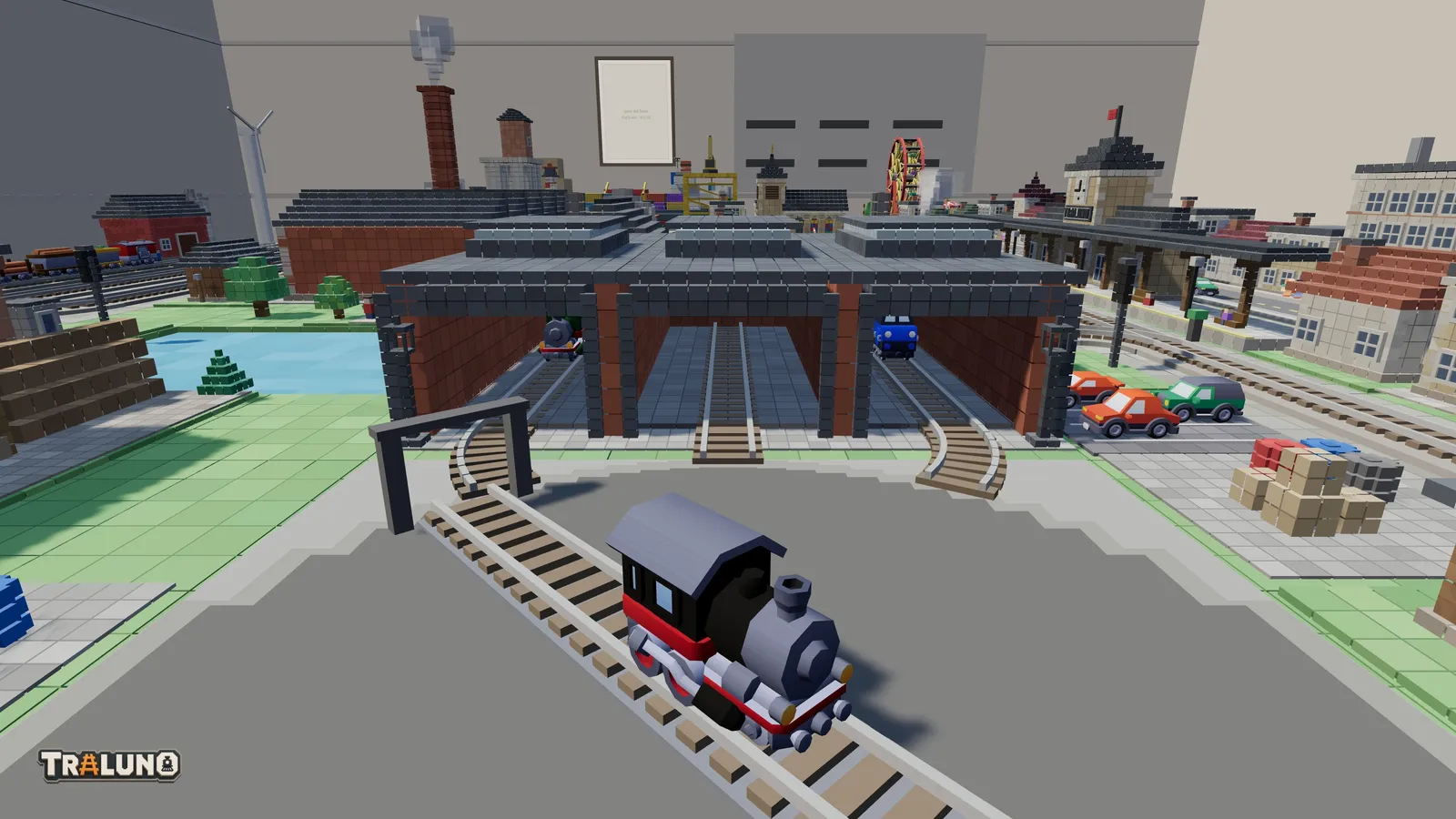
The Turntable and the Roundhouse sit in the Railway section of Traluno's catalogue at $3.99 each, tax included. Placed side by side they make a small engine terminal: a model train turntable whose own steam engine runs in and out of the shed on a loop, while the rest of the layout gets on with its day.
What a turntable is for
A steam locomotive is built to run forwards. It can run backwards, but tender first the crew's view is poor and speeds were often restricted, so at the end of a run the engine was turned round. A turntable does that: a bridge carrying a short length of track, pivoted at its centre in a circular pit, pushed round by hand or driven by a motor. The engine drives on, the bridge swings half a turn, and the engine drives off facing the other way.
It also lets one track serve many. A turntable can line up with any number of tracks around its rim, which is why engine sheds grew up around them. Where there was land to spare, railways turned engines on a triangle of track instead (a wye, in American usage), which needs three turnouts rather than a bridge but far more space. Diesel and electric locomotives with a cab at each end made both less necessary.
What a roundhouse is for
A roundhouse is an engine shed built around a turntable, its stalls radiating from the pit like spokes so that every stall is one swing of the bridge away. Engines were kept there between duties, and serviced and repaired in the stalls. Some were full circles; many were arcs.
As a model train roundhouse, Traluno's is the simpler kind: three parallel stalls in a brick shed, closer to a straight engine shed than to a true roundhouse. That difference is the reason the turntable's approach roads curve, which comes up below.
How Traluno's model train turntable works
The Turntable takes a block of three by three cells, 30 cm square at HO scale. It is a pit with a turning bridge, three approach roads fanned out on one side towards the roundhouse, and a short stub of track on the opposite side.
On the bridge sits its own little steam engine, and it works a fixed cycle:
- The bridge turns until it lines up with one of the three approach roads.
- It pauses, and the engine drives off the bridge, along the road and through the shed door, far enough to be under the roof.
- It waits, then backs out onto the bridge.
- Once it is home, the bridge turns to the next road.
After the third road, the bridge swings round to line up with the stub on the far side, turning the engine to face away from the shed, and then the cycle starts again.
The phases never overlap, on purpose. The engine has to be home on the bridge before the table moves, because a bridge that swung with the engine still out on an approach road would carry it round through the shed wall.
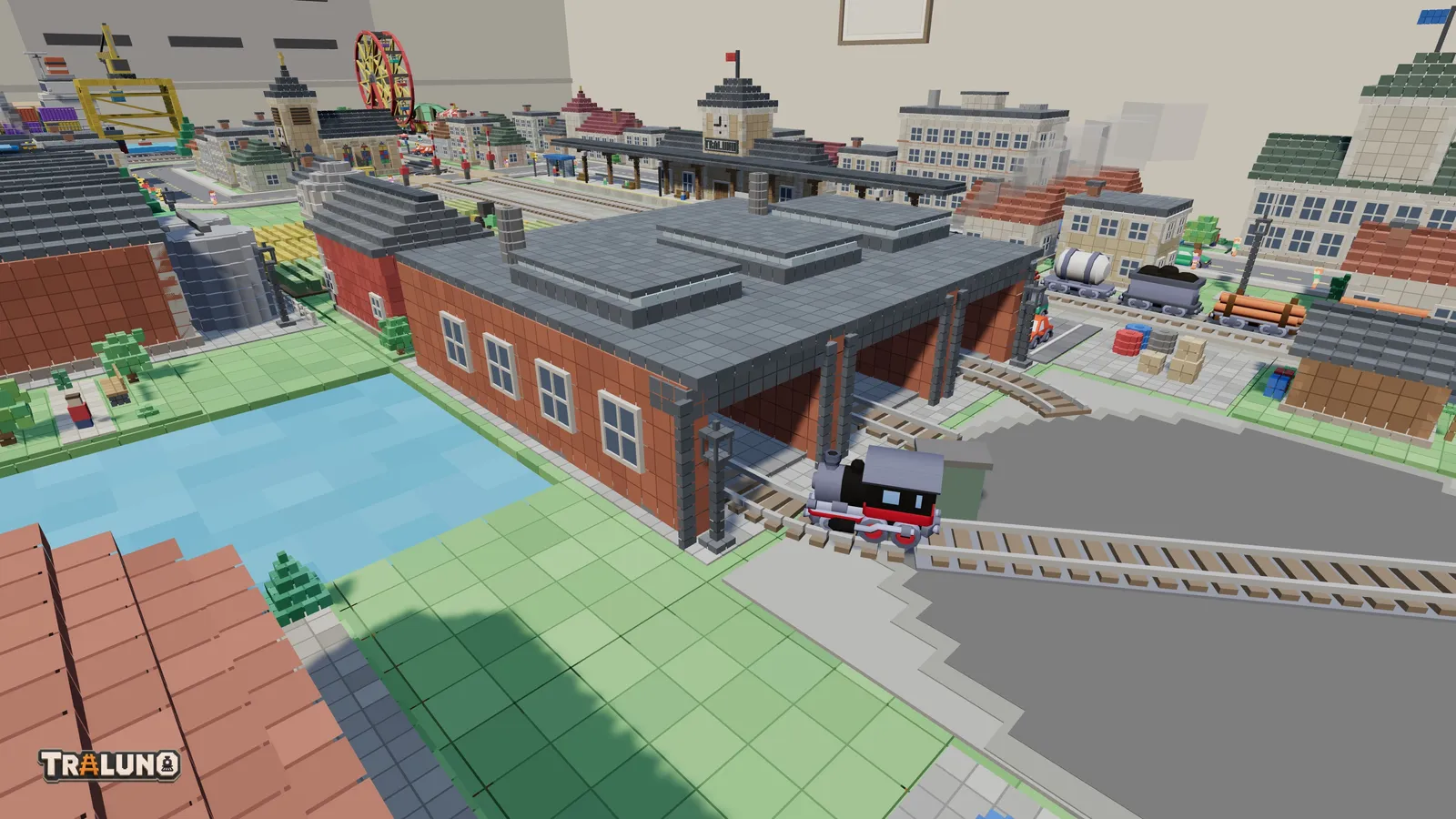
The emergency stop on the desk freezes the turntable mid-swing along with everything else. The WHEEL button, which starts and stops the fairground rides, leaves it alone.
Why the approach roads curve
A turntable can only be left along a radius. The bridge points out from the centre of the pit, so a road leaving it has to start out pointing the same way. The roundhouse's stalls are parallel and ten centimetres apart, so only the middle road can run straight into its stall. The two outer roads leave the pit radially, at an angle, and curve round onto their stall's line, so that each arrives at its shed door pointing straight down the stall.
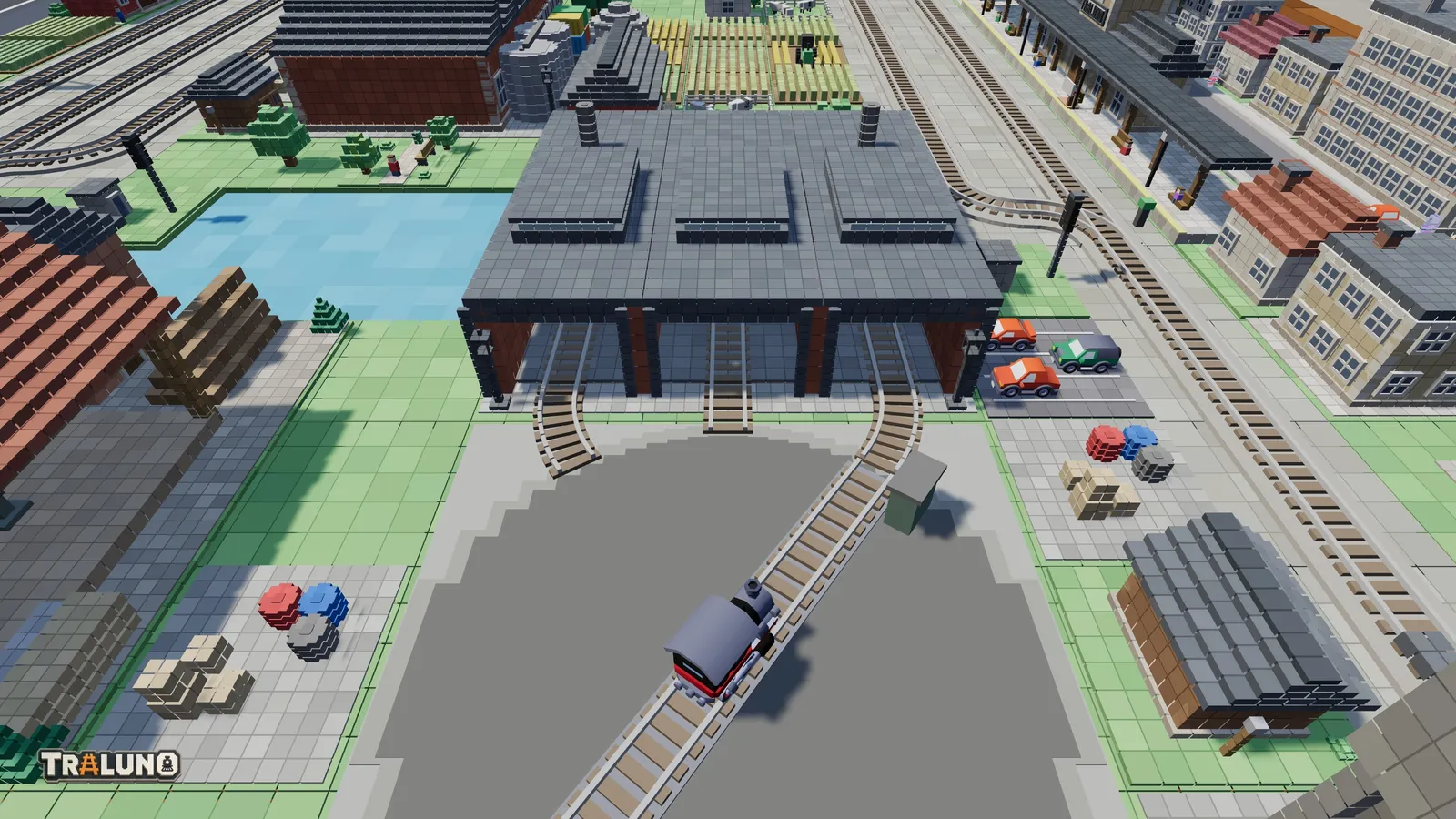
An earlier version joined them with straight lines. Those met the stall roads at thirty degrees and read as two unconnected pieces of track. The curved roads now come from one function, and the little engine drives along the same function, so the rails and the wheels cannot disagree about where a road runs.
The roundhouse
The Roundhouse is also three by three cells: a brick engine house with a slate roof, clerestory glazing along the top, and three stall roads that stop at the doorway, where the shed floor buries their sleepers as a shed floor does. Two of the three stalls have a locomotive parked in them. When the turntable's engine runs into one of those, it stops under the roof and short of the engine already there.
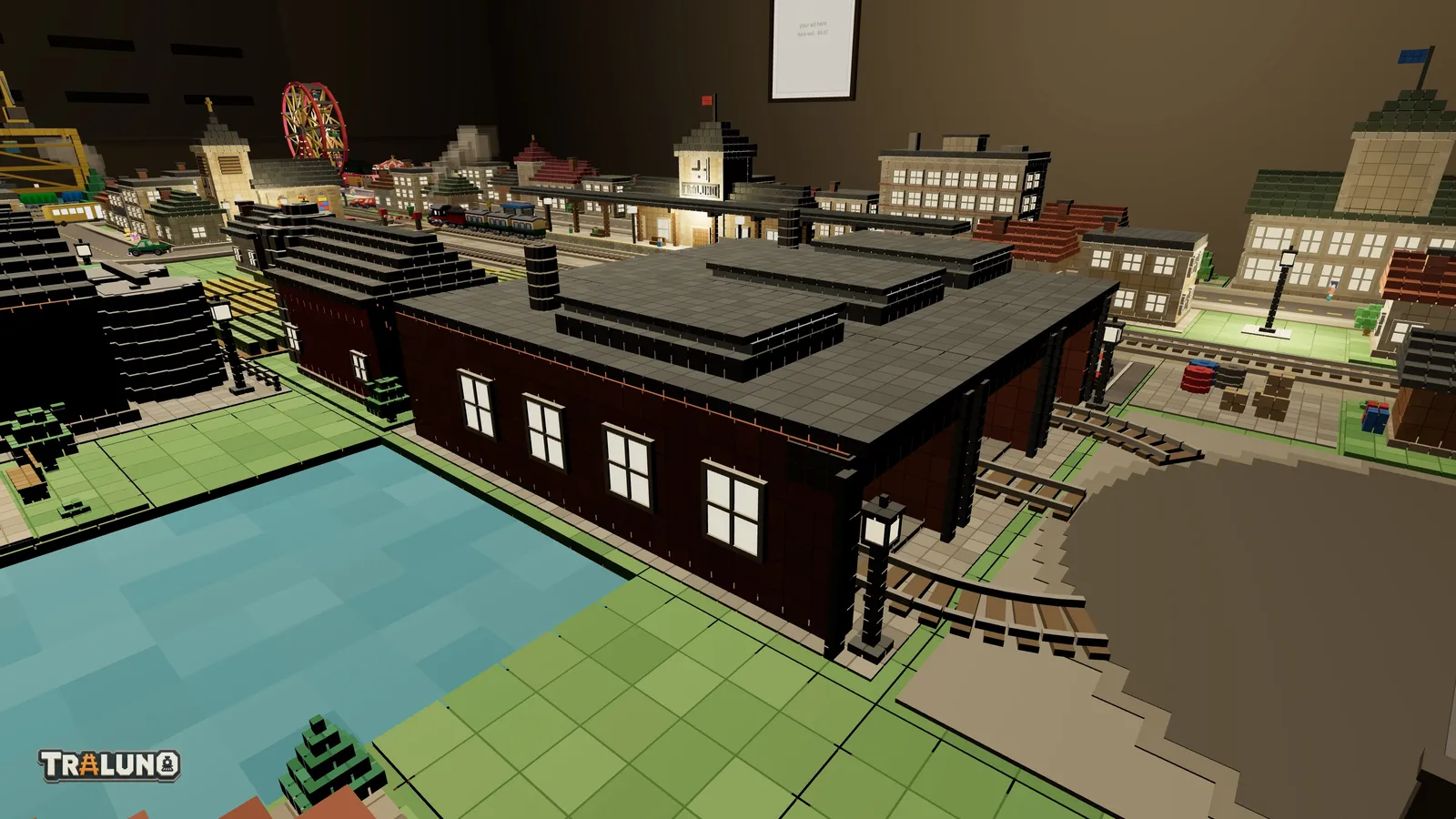
Windows run along both sides and the far end, and a lamp stands at each corner of the door end. Both light up after dark, as long as the LAMPS toggle on the desk is on; When the Lights Come On covers how night works.
Placing the pair
Clear nine cells for each. Neither model can stand on track, road or water, so each needs a clean three-by-three block. Only the mountain and the harbour crane may stand over track.
Put the roundhouse where the roads point. Unturned, the turntable's approach roads point to the right as seen from the front of the table, and the roundhouse's doors face left. Place the roundhouse immediately to the right of the turntable, in the same three rows, and the doors land exactly where the roads end, as on the demo layout. If you turn them with R, turn both by the same amount and keep the roundhouse on the side the roads point to. The placement ghost draws the approach roads, so you can see which way they point before you click. Those cells are the roundhouse's whether you place one or not: to reach the shed, the engine runs past the edge of the turntable's own cells, and it will drive straight through anything else standing there.
Leave the circle alone. The bridge sweeps a circle almost the width of the footprint, and the model keeps nothing static inside it: an earlier version had a ring of kerbstones and an operator's hut there, and the bridge drove through both. As with the loading gauge, the clearance is built into the model rather than checked at placement, and since the turntable owns its nine cells, nothing else can be put inside them.
Running your own trains to it. Your trains do not drive onto the turntable; it is a working model with its own engine, not a piece of track. The stub on the far side of the pit is there to meet a track of yours, and the demo layout runs a short lead off the main line up to it, through a switch you can throw from the Switches window. A train sent up that lead stops at the end of the track and reverses, as it would at a buffer stop. For where a terminal like this fits in a plan, see Model Train Track Plans.
Dress the terminal. On the demo layout the pair stands among free Railway items, the Water Tower, the Coaling Tower and two Signal Masts, with sheds and crates from elsewhere in the catalogue. For more on dressing a layout, see Model Train Scenery Ideas.
Give it a view. The engine cannot be ridden, but a saved camera view on the pit makes the whole cycle a single click to come back to; the cab ride guide covers saving views. The demo scene, which a first visit opens and Reset puts back, has the pair already in place, so open the layout and look on the left-hand side of the table, between the mountain and the front main line.
- guide
- turntable
- roundhouse
- railway buildings