· 8 min read
Model Train Scales Explained: HO, N, OO and O
HO scale is 1:87 on 16.5 mm track. Every common model train scale from Z to G in one table, HO against N for a first layout, and how Traluno uses HO.
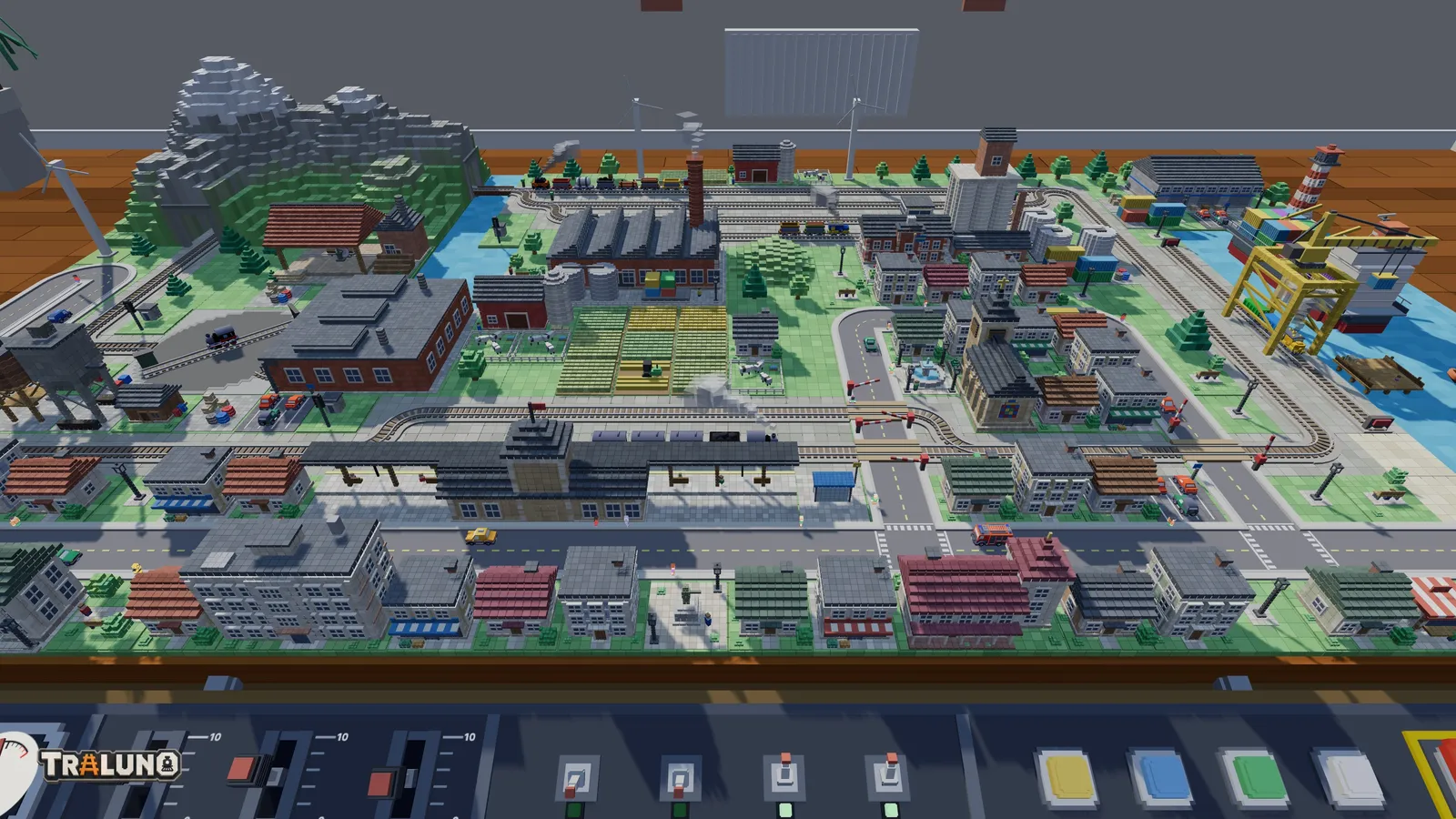
HO scale is 1:87. One millimetre on the model stands for 87 millimetres on the real railway, and standard-gauge HO track measures 16.5 mm between the rails. The other model train scales work the same way with different numbers: a ratio for the models, a gauge for the track, and a name that does not always mean the same thing in every country. Traluno's table, room and people are drawn to HO, and the last part of this post is where its railway is not.
What is HO scale
The name is short for "half O". The NMRA's beginners' guide describes it as half of O scale, with one real foot coming out at about an eighth of an inch. The NMRA gives the ratio as 1:87.1, which is 3.5 mm to the foot. The European standard, NEM 010, published by MOROP, says 1:87 exactly and writes the name H0. Over a 30 cm model the difference between the two is about 0.3 mm, small enough that they are used interchangeably.
Scale and gauge are separate measurements, and the hobby uses both words loosely. Scale is the ratio between the model and the original. Gauge is the distance between the inside faces of the rails. HO's 16.5 mm is real standard gauge, 1,435 mm, divided by 87 and rounded.
The same NMRA guide gives the practical reason HO is the default. The majority of modellers work in it, so it has the widest range of products, and N comes next.
Model train scales at a glance
These are the common scales, smallest first. The ratios and gauges come from NEM 010 and from the NMRA's track standard, S-3.2; where the two disagree, both are given.
| Scale | Ratio | Track gauge | Notes |
|---|---|---|---|
| Z | 1:220 | 6.5 mm | The smallest of the common scales |
| N | 1:160 | 9 mm | 1:148 in Britain, 1:150 in Japan, same track |
| TT | 1:120 | 12 mm | Between N and HO |
| HO | 1:87 (NMRA 1:87.1) | 16.5 mm | Written H0 in Europe |
| OO | 1:76.2 | 16.5 mm | British models on HO track |
| S | 1:64 | 22.5 mm | Between HO and O |
| O | 1:48 (US), 1:45 (NEM) | 32 mm | 1:43.5 is also used |
| G | 1:22.5, among others | 45 mm | The NMRA files it under Large Scale |
For a standard-gauge railway, gauge follows from scale, so a scale and its track usually travel together. OO breaks that on purpose, and N, O and G each have more than one ratio sharing a single track.
Where the names stop agreeing
N: 1:160, 1:148 or 1:150
N is 1:160 in both NEM 010 and the NMRA standard, on 9 mm track. British commercial N is built to 1:148, and Japanese models of conventional lines to 1:150; Shinkansen models, which run on standard gauge, go back to 1:160 (N scale overview). All of them use the same 9 mm track, so a British or Japanese N model stands on rails that are slightly narrow for it.
OO: British models on HO track
OO gauge is 4 mm to the foot, 1:76.2, and it runs on the same 16.5 mm track as HO. At 1:76.2 that track represents a gauge of about 1,257 mm, some 178 mm narrower than the real thing. The Double O Gauge Association, which exists to support the scale, accepts that 16.5 mm "is slightly wrong" and notes that it is still the most popular gauge for UK models.
So OO and HO share track but not scale: an OO model is about 14 per cent larger than an HO model of the same original. One more trap: S-3.2 also defines an OO, at 1:76.2 but on 19.1 mm track. That is the NMRA's own OO, not the 16.5 mm version British ready-to-run models use.
O: 1:48, 1:45 or 1:43.5
In North America O is 1:48, a quarter of an inch to the foot, on track 1¼ in (32 mm) wide. NEM 010 puts European 0 at 1:45 on 32 mm, and adds that 1:43.5, which it calls 7 mm scale, is also used in some countries. One track, three sizes of model.
G and large scale
G is less a scale than a track: 45 mm gauge. S-3.2 groups 1:32, 1:29, 1:24, 1:22.5 and 1:20.3 together as Large Scale on that track, and the NMRA's beginners' guide gives G itself as 1:22.5 while noting that the ratio varies. In NEM 010 the same 45 mm is gauge I, standard gauge at 1:32, and also IIm, metre gauge at 1:22.5.
HO scale vs N scale for a first layout
The NMRA guide ranks HO first and N second for popularity, so a first layout usually comes down to those two. Most of the choice is about space.
N is 87/160 of HO, about 0.54 of the length in every direction. The same track plan built in N needs about 30 per cent of the floor area it needs in HO.
Curves make the difference sharper than the ratio suggests, because the tightest curve sets the smallest board a loop fits on. The NMRA's recommended practice on curvature, RP-11, gives 356 mm (14 in) as the minimum radius for its smallest class of locomotive-hauled HO equipment, and 191 mm (7.5 in) for the same class in N. A full circle at those radii is 71 cm across in HO and 38 cm in N, measured centre line to centre line, before adding the width of the track and a margin to the edge of the board. RP-11 also notes that some entry-level models manage tighter curves than that.
Detail goes the other way. An HO model is 1.84 times the length of the same model in N, so it has about 3.4 times the surface to carry detail and paint. The NMRA guide's argument for N is scenery: in N, it says, the scenery can be made to dwarf the trains, while scenery in the larger scales takes a lot of room.
Cost is the comparison with the least to stand on. The NMRA guide does not rank scales by price, and without a source this post will not either. Space is the cost that is certain, so measure the room before the catalogue. If you have not settled on a shape yet, track plans are easier to judge on a screen than on a board, and a first loop shows how few pieces a circuit needs.
How Traluno uses HO scale
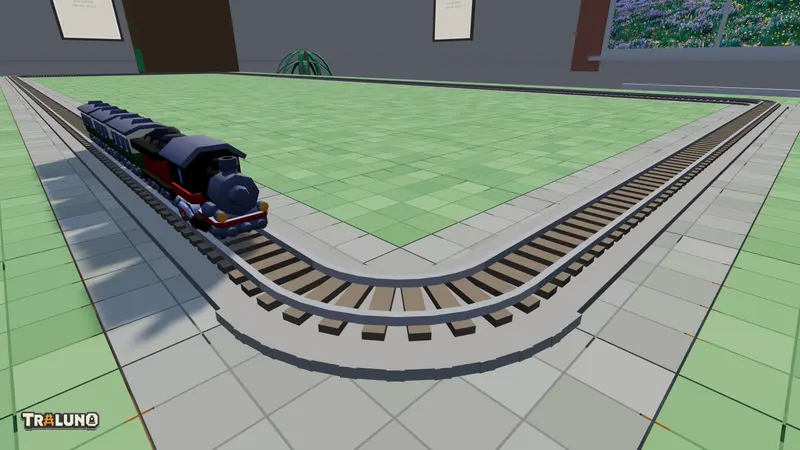
Traluno puts an HO layout on a wooden table in a room, and the numbers in the code are centimetres. A grid cell is 10 units, which the source describes as centimetres per cell, and a table is 30 cells by 16: 300 by 160 units, the 3 m by 1.6 m table the shop sells. The tabletop stands 90 units off the floor. At 1:87 one table represents about 261 m by 139 m of country, and four tables in a square, the most a layout can stand on, about 522 m by 278 m. From one table to four covers how they fit together.
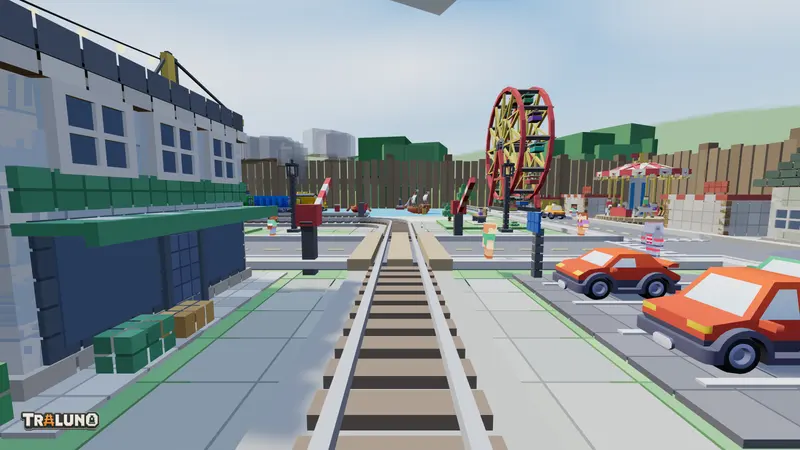
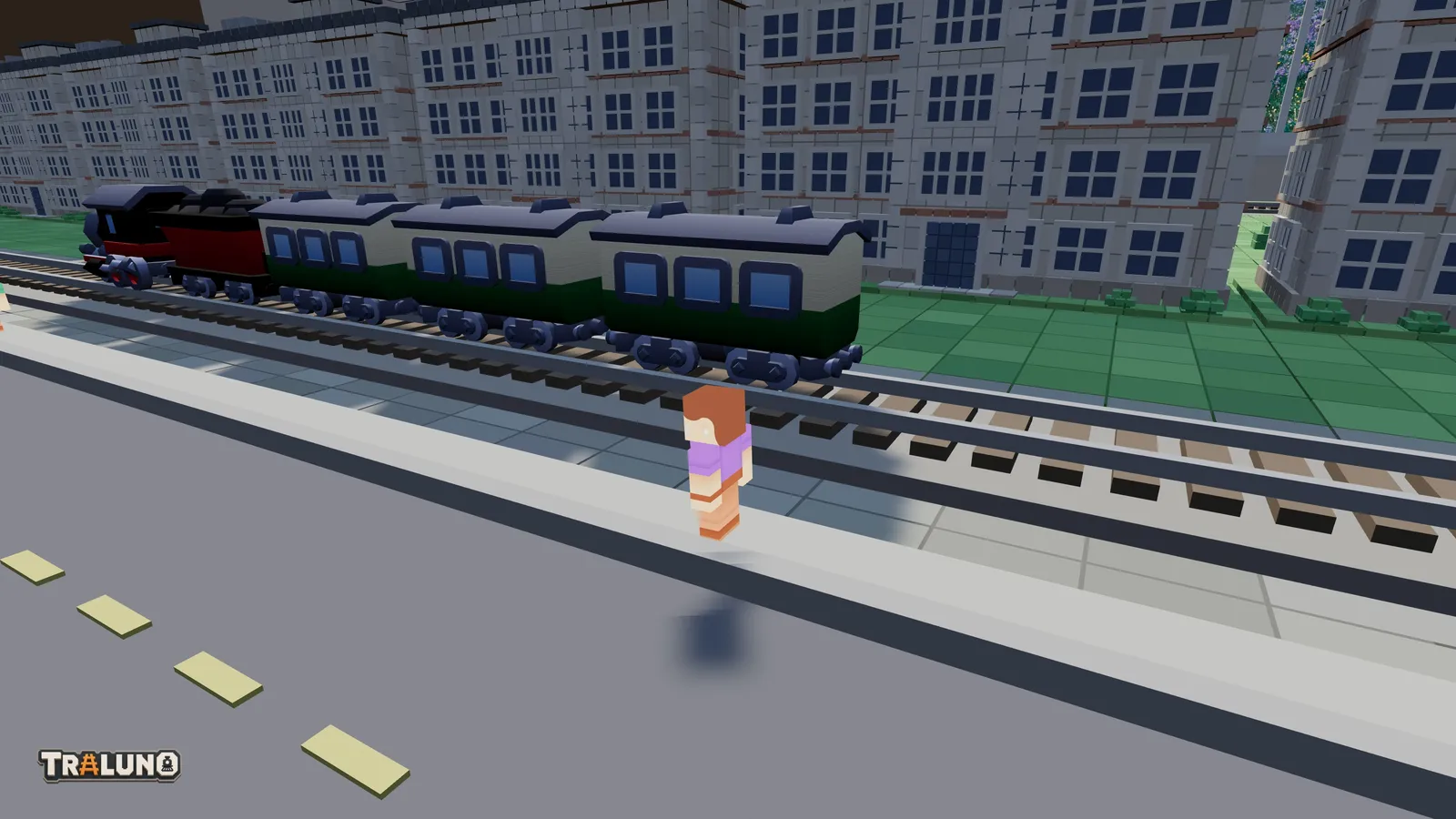
People are drawn to the same scale. A pedestrian stands about 1.74 units tall, and the comment beside the code model calls that 1.5 m at 1:87. The glTF figures that replaced it are scaled to match that height exactly, rather than to body width as the vehicles are. The camera follows the same scale: what the table teaches explains why it stands at the eye height of a person at the front edge.
Where Traluno bends the scale
The table, the room and the people are HO. The railway keeps HO heights but not HO gauge, lengths or curves, and the reasons are worth stating plainly.
The gauge is 19.4 mm, not 16.5. Nominal HO gauge in Traluno's units would be 1.65. The rails are laid 1.94 apart instead, about 18 per cent wide. The gauge was set by the fleet, not by the scale rule: every locomotive and wagon is a Kenney model scaled to body width, and their wheelsets land 1.94 apart. At 1.65, every wheel stood outside the rail with only its inner edge over the head. Read at 1:87, the track represents about 1.69 m between the rails, which in the real world would be a broad-gauge railway.
The cars are short. The same kits are stubby: a Kenney wagon is 2.2 units long for every unit of width, where the code models it replaced were 4. Each car takes between 4.8 and 5.4 units of track, about 4.5 m at 1:87. A coach, at 5.2, is less than a fifth longer than the code-built road car, which is 4.4 units long.
The curves are tight. A curve piece is a quarter circle inside one 10 cm cell, so its radius is half a cell: 5 units, or 50 mm. RP-11's tightest HO figure, for streetcars, is 127 mm, and locomotive-hauled stock starts at 356 mm. It is the same compression as the short cars, applied to the track. Why tight curves break voxel track explains why there is exactly one radius.
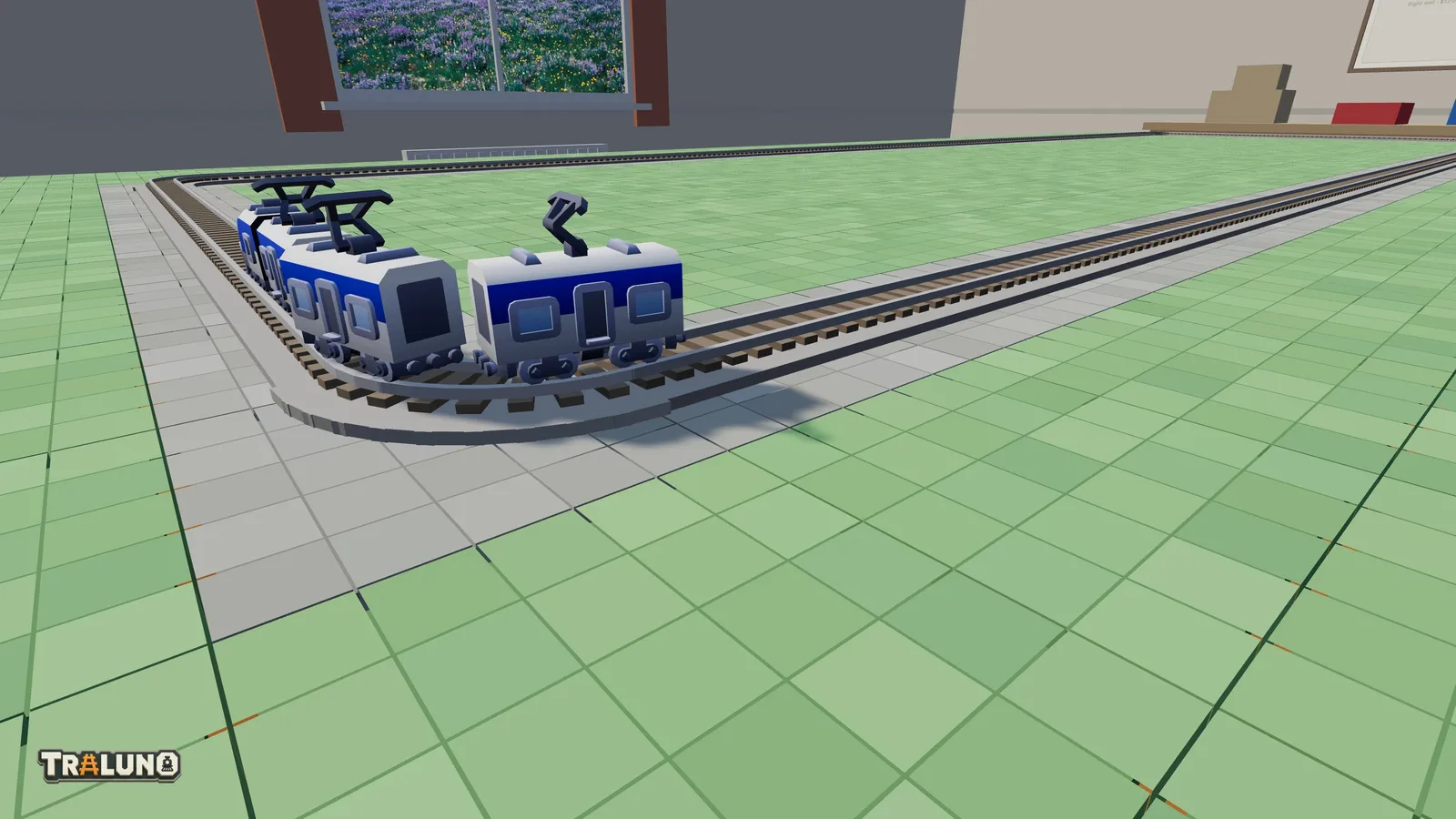
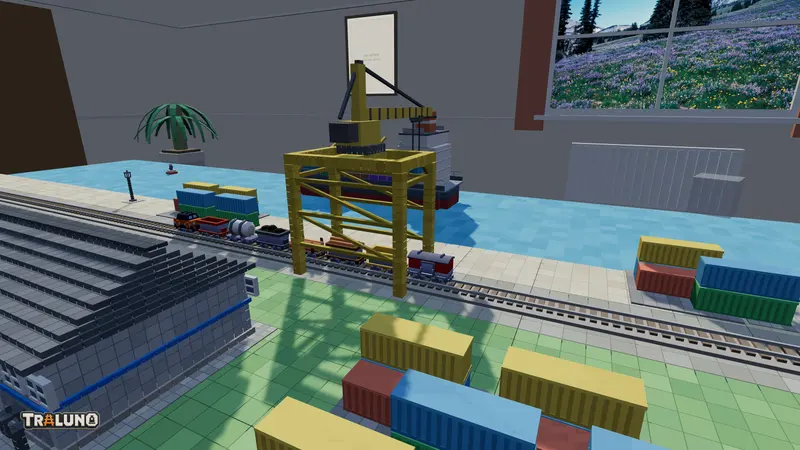
The heights are HO. The track profile is 9 mm from the scenery base to the rail head: 3.5 mm of ballast, 2.5 mm of sleeper and 3 mm of rail, with the rail's height derived from RAIL_Y, the rail head, so the rolling stock always stands on the rail. The tallest vehicle is the electric locomotive with its pantograph raised, 5.95 units above the rail head, which is about 5.2 m at 1:87. With the rail head 0.9 above the ground in an object's own frame, nothing that spans a track may hang lower than about 7.0, and the harbour crane's end ties sit at 12.2. The loading gauge tells how that number was found.
So Traluno is HO wherever you can check the scale against something you know: the table, the room, the people, the clearance under anything that spans the track. It is compressed where a strict 1:87 would need a bigger room, in the length of a train and the radius of a curve. Real layouts make the same trade. RP-11 itself says model equipment is designed for curves much sharper than the prototype's, so that layouts fit the space available.
- scale
- ho scale
- n scale
- oo gauge
- track